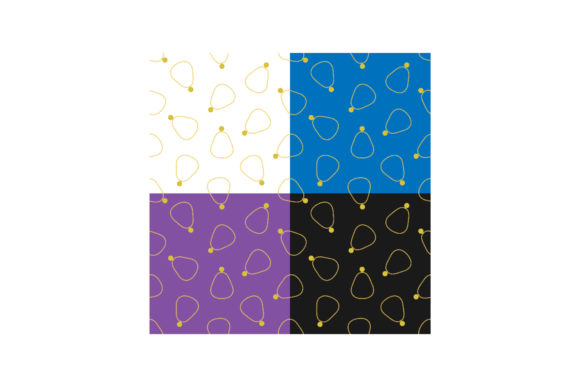
Line Art Faces Patterns Motifs Vector
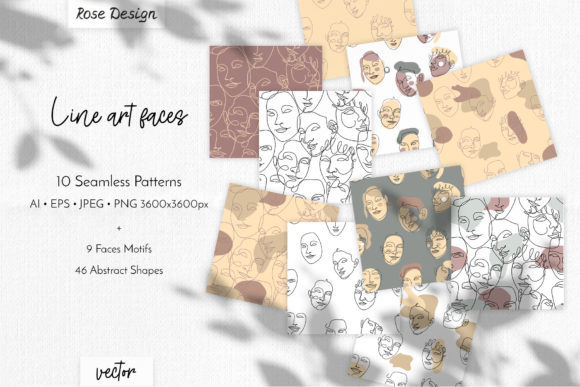
Minimalist line art faces—clean, expressive, and quietly human—have become a quiet language of modern visual communication. When distilled into seamless patterns and paired with abstract shapes in warm, earthy neutrals, they transform from simple illustrations into versatile design assets. The Line Art Faces Patterns Motifs Vector collection is built for this exact shift: from idea to application, from sketch to scalable asset, without sacrificing subtlety or intention.
What Makes These Patterns Stand Out
These aren’t decorative fillers. Each of the 10 seamless patterns is thoughtfully constructed using continuous-line face drawings—no shading, no gradients, just confident, fluid contours that suggest personality without prescribing it. The color palette leans into soft beiges, warm greys, muted terracottas, and oat-like creams: colors that feel grounded, inclusive, and easy to pair with photography, typography, or product photography.
What sets this set apart is its layered flexibility. You’re not just getting patterns—you’re getting the modular parts behind them. Nine original face line drawings (each available as editable vector curves), nine face-and-shape hybrids, and 46 standalone abstract forms give you full control over composition. Adjust stroke weight, recolor on the fly, isolate motifs for logos or icons, or rearrange shapes to build custom repeats. That level of access matters when you’re balancing brand consistency with creative freshness.
Creative Uses Across Real Projects
Designers and small business owners often ask: “Where do I even start?” Here are tangible, tested applications—not hypotheticals:
- Branding & Packaging: Use a subtle face pattern as a background texture on business cards or product labels. It adds warmth without competing with your logo or copy. Try overlaying it at 8–12% opacity on kraft paper or off-white stock for tactile, artisanal appeal.
- Social Media Assets: Turn one of the face motifs into a recurring visual anchor—say, as a profile badge, story highlight icon, or animated watermark. Because all files include transparent PNGs (3600×3600 px), they scale cleanly across Instagram feed posts, Pinterest pins, and YouTube thumbnails.
- Stationery & Print: Apply a seamless pattern to notebook covers, letterpress envelopes, or greeting cards. The EPS10 and AI 2020 files ensure crisp output whether you’re printing locally or uploading to print-on-demand platforms like Printful or Gelato.
- Textile & Surface Design: These patterns tile perfectly—and at high resolution. Test them on tote bags, scarves, or pillow covers. The earthy palette pairs naturally with linen, cotton canvas, or unbleached denim, reinforcing a calm, intentional aesthetic.
- Educational & Workshop Materials: Educators and workshop facilitators use the editable face curves to demonstrate line quality, rhythm, and negative space. Project one motif, then invite participants to reinterpret it with their own strokes—turning theory into tactile learning.
How Different Users Can Adapt Them
A freelance illustrator might extract a single face drawing, adjust its curve handles in Illustrator, and integrate it into a custom brand mark—keeping the line’s character but aligning it with a client’s voice. A blogger could layer a low-opacity pattern behind a quote graphic, letting the repetition suggest community or shared experience without visual noise.
For marketers launching a wellness or mindfulness product, these patterns offer an alternative to overused botanicals or generic zen symbols. A face line drawing implies presence; the continuous line suggests flow and connection—ideas that resonate with audiences seeking authenticity over perfection.
Hobbyists and crafters appreciate that every file is production-ready: JPEGs for quick mockups, transparent PNGs for digital overlays, and fully layered AI files for deep customization. No hunting for fonts, no wrestling with raster artifacts—just clean, organized assets on named artboards.
Staying Clear, Consistent, and Audience-Friendly
When working with minimalist line art, clarity comes from restraint—not complexity. Here’s how to keep results effective:
- Limit color variation in final layouts. Stick to your base neutral palette plus one intentional accent (e.g., charcoal black for text, or a single warm tone for buttons). The patterns already carry visual interest—don’t overload them.
- Test readability early. If placing text over a pattern, check contrast at multiple sizes. A 10% opacity overlay or light/dark mode toggle can preserve legibility without losing texture.
- Match motif scale to context. A tiny face repeat works beautifully on fabric or web backgrounds; a large-scale isolated motif reads better on signage or presentation slides. Use the included 3600-px PNGs to preview at real-world sizes.
- Respect the line’s intent. These aren’t caricatures or portraits—they’re suggestions of expression. Let them breathe. Pair them with generous white (or off-white) space to maintain their quiet strength.
Why This Collection Fits Right Now
In a landscape saturated with maximalist graphics and AI-generated clutter, there’s growing demand for design that feels handmade, intentional, and human-scaled. The Line Art Faces Patterns Motifs Vector collection meets that need—not by chasing trends, but by offering tools that support thoughtful making. Whether you’re refreshing a Shopify store, designing a conference identity, or creating classroom visuals, these assets work because they’re built on clarity, modularity, and warmth.
You don’t need to be a vector expert to use them—but if you are, the editable curves and layered AI file open up deeper customization. And if you’re just starting out? The JPEGs and PNGs let you jump in immediately, test ideas fast, and refine as you go.
Design isn’t about having every option—it’s about having the right ones, ready when you need them. With Line Art Faces Patterns Motifs Vector, the foundation is set. What you build on it is entirely yours.