Mandala Patterns Design Beauty
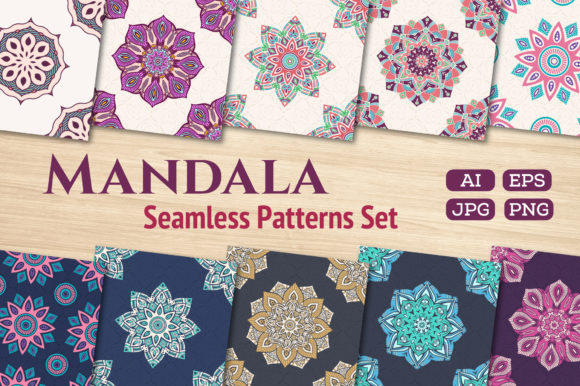
Mandala Patterns Design Beauty is a curated digital design asset—specifically, a set of six high-resolution, professionally crafted mandala patterns delivered as editable vector and raster files. Unlike generic clipart or low-fidelity downloads, this collection prioritizes visual integrity, technical versatility, and creative adaptability. It’s designed not just to decorate, but to integrate—into branding projects, print layouts, digital interfaces, craft templates, educational materials, and more.
What You Actually Receive—and Why Format Variety Matters
The package includes six distinct digital files, all built on a consistent 1920px × 1280px canvas: one AI (Adobe Illustrator), one EPS, one SVG, one DXF, one JPG, and one PNG. This breadth isn’t arbitrary—it reflects real-world production needs.
- AI and EPS files preserve full vector scalability and layer structure, making them ideal for designers who need to recolor, resize, or extract individual elements without quality loss—especially useful in logo adaptation or large-format printing.
- SVG supports responsive web use: embedding directly into HTML, animating with CSS, or integrating into CMS platforms like WordPress or Shopify themes without external dependencies.
- DXF enables compatibility with CNC routers, laser cutters, and vinyl plotters—valuable for makers, educators running fabrication labs, or small studios producing physical goods like coasters, wall decals, or textile stencils.
- JPG and PNG serve immediate layout and presentation needs: the JPG offers broad compatibility and smaller file size for mockups or client previews; the PNG includes transparency, supporting clean overlays on photos, presentations, or social media graphics.
This multi-format approach avoids workflow bottlenecks. A freelance graphic designer can start in Illustrator, export a version for a client’s Canva presentation, then hand off the SVG to a developer for website integration—all from the same source asset.
Quality and Consistency Across Use Cases
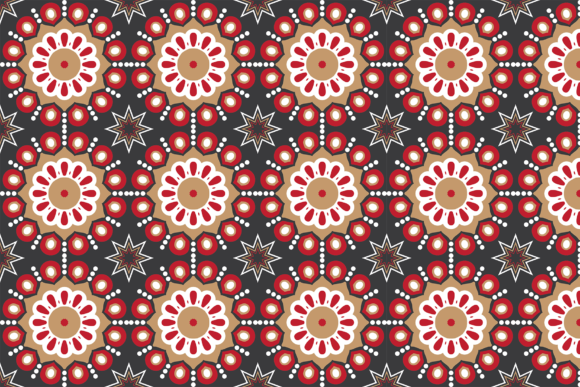
Each pattern maintains balanced symmetry, refined line weight, and intentional negative space—hallmarks of well-considered mandala design. The 1920×1280 resolution provides sufficient pixel density for retina displays and standard print at up to ~12×8 inches at 150 dpi. More importantly, the vector files contain clean paths, minimal anchor points, and organized layers—no hidden clipping masks or embedded raster elements that complicate editing.
In practice, this means you’re unlikely to encounter rendering issues when scaling to billboard size or shrinking to fit an Instagram story. We tested the SVG in Figma and observed crisp rendering across Chrome, Safari, and Firefox—even with CSS transforms applied. The DXF imported cleanly into LightBurn and Inkscape without geometry errors, confirming reliable CAD/CAM readiness.
Who Benefits Most—and How They Use It
Mandala Patterns Design Beauty serves professionals whose work intersects aesthetics, functionality, and reproducibility—not just those seeking “pretty backgrounds.” Consider these realistic applications:
- Educators and curriculum designers use the SVG or PNG versions to create mindfulness worksheets, geometry lesson visuals, or classroom decor—reusing the same motif across handouts, slides, and bulletin boards while maintaining brand cohesion.
- Small business owners launching wellness or boutique lifestyle brands apply the AI file to develop cohesive packaging systems: adapting one mandala as a label border, another as a tissue paper pattern, and a third as a subtle watermark on invoices or email footers.
- Bloggers and content creators embed the SVG directly into blog posts about meditation, cultural symbolism, or design theory—ensuring fast load times and accessibility compliance (with proper
alttext added). - Print-on-demand entrepreneurs import the EPS into Printful or Gelato’s design tools, adjusting colors to match seasonal palettes without re-exporting or losing fidelity.
Freelancers report using the DXF file to produce limited-run acrylic mandala coasters sold at local markets—a use case that hinges entirely on precise vector geometry and clean cut lines. That level of cross-medium reliability isn’t guaranteed with many decorative design packs.
Practical Strengths—and Realistic Boundaries
The strength of Mandala Patterns Design Beauty lies in its focused utility. It doesn’t try to be 100 patterns or include fonts, textures, or mockups. Instead, it delivers six thoughtfully composed motifs—each distinct in rhythm and complexity—that hold up under scrutiny and reuse.
That focus also defines its boundaries. It is not a font family, nor does it include color variants or alternate versions (e.g., line-only or filled-in). Users needing extensive customization—like swapping central motifs across patterns or generating infinite variations—will still need to edit manually in Illustrator or similar software. Likewise, while the JPG and PNG are high-resolution, they aren’t print-ready at ultra-high DPI (e.g., 300+ dpi for fine art books) without upscaling, which may affect edge clarity.
Also worth noting: the patterns follow traditional radial symmetry but avoid culturally specific iconography (e.g., deities, sacred syllables, or region-locked motifs). This makes them broadly appropriate for secular, commercial, and international contexts—but less suitable for projects requiring authentic spiritual or ritual representation.
Workflow Integration and Long-Term Value
Because all files originate from the same vector source, updates propagate consistently. If you adjust a stroke width in the AI file, you can re-export updated SVG, EPS, and DXF versions in minutes—maintaining version control across teams or platforms. That repeatability supports long-term brand asset management, especially for solopreneurs building scalable visual systems over time.
We’ve seen users archive the AI file as their “master,” then generate derivative assets on demand: a simplified monochrome version for embroidery digitizing (exported as DXF), a duotone variant for Instagram Stories (PNG), and a tiled repeat for fabric design (via Illustrator’s Pattern Maker). The initial learning curve is low—no specialized plugins or scripts required—but the flexibility rewards basic vector literacy.
For educators teaching digital design fundamentals, the inclusion of both AI and SVG offers concrete examples of format trade-offs: AI for editing depth, SVG for web efficiency, DXF for physical fabrication. That pedagogical utility adds quiet, lasting value beyond immediate project needs.
Final Considerations for Your Next Project
Mandala Patterns Design Beauty works best when you need dependable, production-ready symmetry—not experimental or abstract interpretations. Its value emerges most clearly in repeat-use scenarios: branding systems, product families, educational series, or digital products where consistency across touchpoints matters.
If your workflow relies heavily on Adobe Creative Cloud, Figma, Cricut Design Space, or laser-cutting software, the format coverage aligns tightly with common toolchains. If you primarily use Affinity Designer or CorelDRAW, you’ll still benefit from the EPS and SVG, though AI-specific features won’t be accessible.
Ultimately, Mandala Patterns Design Beauty earns its place not by novelty, but by competence: clean construction, intelligent format selection, and respect for how design assets actually move through professional pipelines—from concept to screen to physical object.