25 Cute Nautical Seamless Patterns
For designers, small business owners, educators, and craft-based entrepreneurs, finding high-quality, production-ready pattern assets is rarely about aesthetics alone—it’s about workflow efficiency, scalability, and consistent output. 25 Cute Nautical Seamless Patterns fits precisely into that operational gap: a curated, technically robust collection designed to move seamlessly from concept to physical product without rework, resizing, or compatibility headaches.
What It Is—and Where It Fits in Your Process
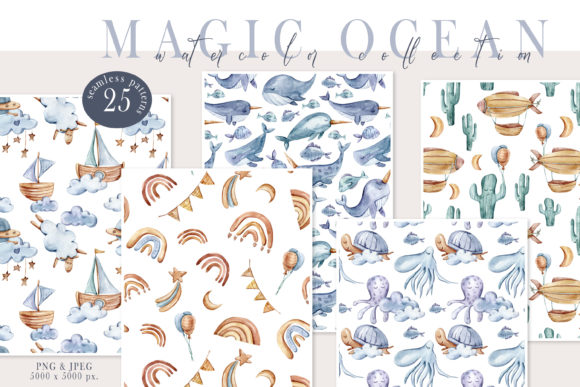
This collection isn’t just decorative—it’s a functional design asset pack built for real-world execution. It contains 25 original watercolor-style nautical patterns, each delivered as both JPEG and PNG files at 300 DPI and 5000 × 5000 pixels. The PNGs include transparent backgrounds, enabling immediate use on any color substrate—whether you’re laying a pattern over navy fabric, printing onto light blue stationery, or overlaying it onto a coral-toned mug mockup.
Unlike generative AI outputs or low-resolution web graphics, these patterns are pre-tested for seamlessness: no visible repeats, no alignment artifacts, no pixelation when scaled. That means they integrate cleanly into your existing tools—Adobe Illustrator for vector-based textile layouts, Affinity Designer for print-ready wallpaper prep, Canva for quick social media templates, or Procreate for custom scrapbook paper design. You don’t need to troubleshoot tiling logic or adjust bleed margins before sending to print.
How It Supports Planning, Not Just Decoration
Before launching a children’s boutique line, planning a themed classroom environment, or developing a summer camp curriculum, visual consistency matters—not as an afterthought, but as part of early-stage scoping. 25 Cute Nautical Seamless Patterns serves this phase by offering a unified visual language: anchors, seashells, starfish, rope knots, and gentle wave motifs—all rendered with soft watercolor texture and balanced negative space. That cohesion helps stakeholders (clients, teachers, co-founders) quickly align on tone and audience fit.
For example, a small business owner preparing a product line for a coastal-themed baby clothing brand can use one pattern for onesies, another for crib sheets, and a third for gift wrap—all while maintaining brand recognition. No need to commission separate illustrations or risk mismatched styles across vendors. The collection becomes a shared reference point during vendor briefings, packaging design sprints, or even parent-teacher committee presentations.
Integration With Common Tools and Platforms
These patterns work where you already do the work. In Adobe Photoshop or GIMP, paste the PNG directly onto a layer and apply layer masks or blending modes for subtle overlays on product photos. In Cricut Design Space or Silhouette Studio, import the JPEG and use the “Print Then Cut” workflow for custom iron-on transfers—ideal for tote bags or swimwear labels. For educators creating printable resources, the high resolution ensures crisp detail even when shrunk to fit A4 or letter-sized activity sheets.
If you’re using Printful, Gelato, or similar print-on-demand services, upload the files directly—they accept 300 DPI JPG/PNG at 5000 × 5000 px without resampling. That eliminates the common bottleneck of downscaling from oversized files or upscaling blurry previews. And because each file is individually named (e.g., “Nautical_Anchor_Watercolor_Pattern_07.png”), organizing them in cloud folders, versioning them across team drives, or tagging them in digital asset management systems remains straightforward.
Practical Implementation Tips
- Start with scale testing: Before committing to large-format printing, test one pattern on a 8.5" × 11" sheet. Observe how the repeat behaves at different zoom levels—this reveals subtle alignment issues that only appear in physical output.
- Use transparency intentionally: Don’t assume all backgrounds will be white. Try layering a shell motif over soft teal or sand-colored gradients in your design software to preview contrast and legibility—especially important for children’s products where clarity supports early literacy cues.
- Batch-process for consistency: If applying patterns to multiple garment types (e.g., t-shirts, leggings, bibs), use global swatches or linked smart objects so a single edit propagates across all files—reducing version drift and ensuring color fidelity.
- Preserve originals: Keep the untouched 5000 × 5000 px files in a dedicated “source assets” folder. Save resized or edited versions with clear suffixes (e.g., “_for_mug_print”, “_web_optimized”) to avoid accidental overwrites.
Quality Control and Long-Term Usability
Each pattern was created with commercial reuse in mind—not just for personal projects but for resale and distribution. There are no embedded watermarks, no third-party licenses to track, and no attribution requirements. That simplifies legal review cycles, especially for publishers releasing activity books or educators distributing classroom materials under school IP policies.
The watercolor aesthetic also adds durability: unlike hyper-realistic vector icons or photorealistic textures, these patterns age well. They won’t look dated next season, nor do they compete with photographic elements in mixed-media layouts. Their soft edges and organic variation support accessibility too—lower contrast than sharp geometric prints, making them easier on developing eyes and neurodiverse learners.
For Freelance Surface Pattern Designers
You’re pitching a nautical-themed nursery collection to a home goods client. Instead of building patterns from scratch during discovery, use 25 Cute Nautical Seamless Patterns as a foundational mood board. Export three variations—one with denser spacing for quilting cotton, one with wider repeats for wallpaper, one simplified for embroidery digitizing. This demonstrates technical fluency and accelerates feedback loops.
For Small Business Owners Launching a Product Line
You’ve sourced organic cotton rompers and muslin swaddle blankets. Rather than waiting weeks for custom pattern development, license this collection, run color tests on fabric swatches, and finalize SKU-specific designs before your first production run. That compresses time-to-market by 2–3 weeks—and gives you flexibility to A/B test which motifs drive higher engagement on Instagram or Etsy listings.
For Educators Building Themed Learning Kits
You’re assembling a “Life at Sea” unit for kindergarten. Use one pattern as background for flashcards, another for laminated name tags, and a third for printable reward charts. Because all 25 share tonal harmony, students experience visual continuity across activities—supporting memory retention and reducing cognitive load during transitions between tasks.
Preparation and Compatibility Considerations
No special software is required—but preparation matters. Confirm your printer or manufacturer’s minimum resolution requirements (most require ≥300 DPI at final print size). Since these files meet and exceed that standard, you’ll avoid last-minute upsampling. Also verify whether your platform supports transparent PNGs: some e-commerce builders flatten layers automatically, so preview exports before publishing.
Finally, consider organization early. Create subfolders labeled by use case (“Fabric”, “Paper”, “Digital”) and add metadata (e.g., XMP tags in Bridge or File Explorer properties) noting motif type and recommended scale range. This pays dividends when revisiting the collection six months later—or handing off assets to a new team member.
Why This Collection Delivers Beyond Aesthetics
In practice, 25 Cute Nautical Seamless Patterns reduces friction at three key points: decision fatigue (no endless searching for “just right” motifs), execution risk (no guesswork about print readiness), and scalability (one purchase supports dozens of applications). It doesn’t replace creative judgment—it removes barriers to applying it consistently.
That makes it valuable not just for what it contains, but for how it fits: as infrastructure, not decoration. Whether you’re iterating on a prototype, preparing for back-to-school orders, or building a seasonal content calendar, having 25 production-grade patterns ready to deploy means more time spent refining messaging, testing usability, or connecting with your audience—and less time troubleshooting file formats or chasing licensing details.