Mushroom Background - Seamless Patterns
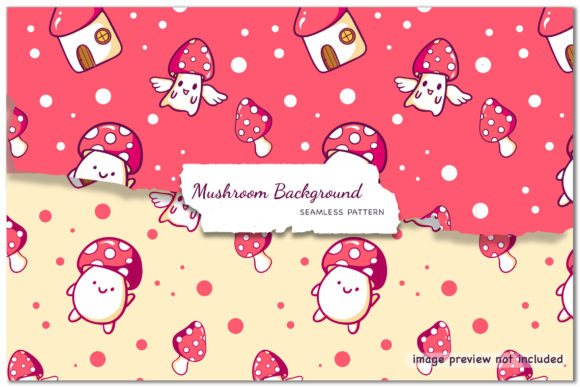
Whether you're designing a whimsical brand identity, crafting social media templates, or building an educational presentation, Mushroom Background - Seamless Patterns offers a subtle yet distinctive visual texture—organic, earthy, and quietly sophisticated. Unlike generic nature motifs, these patterns feature carefully drawn mushroom silhouettes, caps, stems, and gills arranged to repeat flawlessly across any surface. The “seamless” part isn’t just marketing jargon: it means no visible joins when tiled, whether on a website banner, packaging mockup, or printed fabric swatch.
Why this matters more than you might think
Many designers reach for mushroom-themed assets without checking if they’re truly seamless—or even scalable. A background that looks fine at 500px wide can fracture into misaligned repeats at full desktop width. Others assume “mushroom pattern” implies cartoonish or psychedelic styles, missing the elegance of minimalist line work or muted botanical palettes. That mismatch leads to inconsistent branding, awkward cropping in Canva or Figma, or worse—rework after a client review.
Common oversights—and how they quietly undermine your work
Assuming file format equals flexibility. You’ll find Mushroom Background - Seamless Patterns offered in EPS CC, AI CC, JPEG, and PNG—but each serves a distinct purpose. EPS and AI files preserve vector scalability and editable layers (ideal for customizing colors or isolating elements in Illustrator). JPEGs are flat, compressed, and resolution-dependent—fine for web banners but useless if you need to recolor a single mushroom cap. PNGs offer transparency, yes—but only at the resolution they’re exported. A 3000×3000px PNG won’t scale crisply to a 6ft trade show backdrop without pixelation.
Overlooking color mode and embedded profiles. If you’re printing business cards or product labels, RGB JPEGs won’t translate accurately to CMYK press runs. Some free or low-cost mushroom patterns ship without embedded color profiles, causing unexpected shifts when opened in Photoshop or InDesign. What looked like soft sage green on screen may print as olive or grey-green—especially with mushroom tones, where subtle variations in cap shading or stem warmth affect perceived mood.
Treating “seamless” as a one-size-fits-all trait. Not all seamless patterns tile the same way. Some repeat on a strict grid (vertical/horizontal), while others use diagonal or brick-style offsets. If your layout relies on vertical rhythm—like a newsletter sidebar or Instagram story template—a diagonal-repeat pattern can visually disrupt alignment. Worse, some “seamless” downloads are merely cropped JPEGs with no true tiling logic, revealed only when you try to fill a large artboard.
What to verify before downloading or buying
Before adding Mushroom Background - Seamless Patterns to your project:
- Check the tile dimensions. Look for specs like “1200×1200px tile size” or “vector artboard size.” This tells you exactly how far the pattern repeats—and whether it’ll align cleanly with common web or print grids (e.g., multiples of 8px for UI design, or divisible by standard paper sizes).
- Confirm layer organization (in AI/EPS). Open the AI CC version in Illustrator and inspect the Layers panel. Are mushrooms grouped logically? Are base textures, shadows, and highlights on separate layers? Clean layering lets you mute a shadow layer for light-mode interfaces or swap cap colors without redrawing.
- Test transparency handling. Drop the PNG into a design tool with a non-white background. Does the edge blend smoothly, or is there a faint halo? Poor anti-aliasing or semi-transparent edges often indicate rushed export—not ideal for overlay text or logos.
- Review licensing scope. Some bundles allow unlimited commercial use; others restrict resale in templates or SaaS platforms. If you’re a freelancer building client websites or an educator distributing worksheets, verify permissions cover your use case—not just “personal use.”
Better choices start with intention—not convenience
Instead of grabbing the first mushroom pattern labeled “seamless,” take two minutes to ask: What’s the end context? A blog header needs fast-loading, web-optimized JPEG or SVG (if vector-based). A textile designer needs high-res TIFF or PSD with Pantone references. A teacher creating printable flashcards benefits most from crisp, B&W-friendly PNGs with generous margins—so no critical details get trimmed on home printers.
For example: A small bakery launching seasonal mushroom-themed packaging used a JPEG version of Mushroom Background - Seamless Patterns for digital mockups—but switched to the EPS file when sending to their printer. Why? Because the EPS preserved spot-color separations for their forest-green ink, avoided RGB-to-CMYK conversion errors, and let them adjust stem density to match label curvature without blurring.
Similarly, a freelance UX writer building a wellness app interface tested three mushroom patterns side-by-side—not just for aesthetics, but for readability. One had high-contrast caps against a dark base, making white body text pop. Another used low-contrast greys that forced heavier font weights and larger spacing to maintain legibility. The choice affected not just visuals, but accessibility compliance and user fatigue.
Final note: Seamless doesn’t mean effortless
Mushroom Background - Seamless Patterns gives you a strong foundation—but it still requires thoughtful application. Don’t skip testing at actual size. Don’t assume transparency = automatic adaptability. And don’t overlook how lighting, typography, and adjacent imagery interact with organic textures. Mushrooms evoke groundedness and quiet growth; your design should reflect that intention—not just fill space.
If you’re evaluating options, prioritize clarity over quantity. One well-documented, properly formatted Mushroom Background - Seamless Patterns file—complete with vector flexibility, accurate color handling, and predictable tiling—saves more time than five “almost-right” alternatives. It’s not about owning more assets. It’s about using the right one, intentionally, and knowing exactly why it works.