Folk Art Florals - Seamless Patterns: A Practical Guide for Designers and Crafters
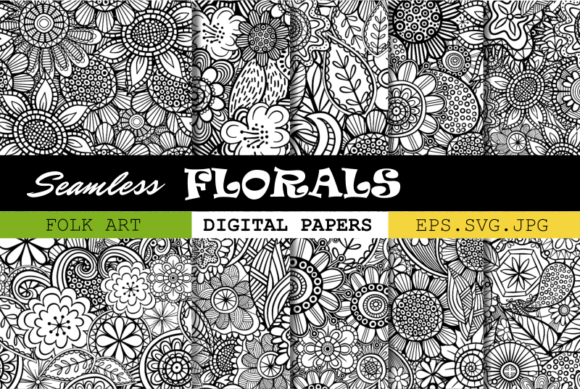
Folk Art Florals - Seamless Patterns is a curated digital collection of ten original, hand-inspired floral motifs rendered in bold black-and-white linework. Designed with folk art sensibilities—think rhythmic asymmetry, expressive stems, stylized blossoms, and organic leaf forms—each pattern repeats cleanly across any surface without visible seams. Unlike generative or AI-assisted floral repeats, these were drawn deliberately to balance visual warmth with structural precision. The set prioritizes versatility through format flexibility: every design is delivered as a high-resolution JPG (300 dpi, 6944 × 6944 px), plus vector-based SVG and EPS files—ensuring scalability from greeting card borders to large-format wall decals.
What Sets Folk Art Florals - Seamless Patterns Apart
The defining characteristic isn’t just the folk aesthetic—it’s how that style translates into functional, production-ready assets. Many floral pattern libraries lean toward botanical realism, watercolor softness, or minimalist geometry. Folk Art Florals - Seamless Patterns occupies a distinct niche: it embraces intentional imperfection—slightly uneven petal counts, hand-drawn line weight variation, and playful negative space—while maintaining technical reliability. That duality makes it especially useful for projects where personality matters but reproducibility can’t be compromised.
Because all ten designs are monochrome, they sidestep color-matching constraints common in pre-colored pattern packs. You’re not locked into someone else’s palette—you choose ink, thread, paint, or screen-print ink based on your medium and audience. This also means the files adapt readily to laser engraving, embroidery digitizing (when traced), or relief printing—uses where color layers or raster complexity would hinder output.
Comparing Formats: When Vectors Matter—and When They Don’t
The inclusion of both SVG and EPS vector formats adds meaningful flexibility. SVG works seamlessly in modern web tools (Figma, Illustrator, Canva Pro), while EPS remains compatible with legacy print workflows and older RIP software. If you’re designing for apparel screen printing or vinyl cutting, vectors let you adjust stroke widths, isolate elements, or convert lines to paths without pixelation—even at billboard scale. In contrast, the included JPGs serve well for quick mockups, social media previews, or backgrounds in non-vector-native apps like Photoshop or Affinity Photo.
That said, vector files aren’t universally necessary. For digital coloring books or printable PDFs intended for home printers, the 300 dpi JPGs are often sufficient—and faster to load and edit. Similarly, if you’re using the patterns strictly as reference for hand-drawn reinterpretation (e.g., sketching custom ceramics or illustrating children’s book scenes), the black-and-white raster files may be more intuitive to trace over than editable vectors.
Use Cases Where Folk Art Florals - Seamless Patterns Delivers Clear Value
This set shines in contexts where authenticity, tactile feel, and narrative resonance matter more than photorealism. Consider these practical applications:
- Handmade product packaging: Stamped onto kraft paper tags, embossed onto soap wraps, or silkscreened onto cotton drawstring bags—the bold outlines hold up well under texture-heavy substrates.
- Adult coloring resources: Each design offers generous white space, clear contours, and balanced density—avoiding the visual fatigue common in overly intricate mandala-style repeats.
- Surface pattern design foundations: Use individual motifs as starting points: recolor one element red for a holiday variant, rotate a stem to create directional flow, or layer two patterns at different opacities for depth.
- Educational illustration: Art teachers use these to demonstrate pattern structure, repetition logic, and folk art conventions—without needing advanced software skills.
A graphic designer creating branding for a small-batch herbal tea line might choose Folk Art Florals - Seamless Patterns over a generic floral repeat because the style signals craft, regional tradition, and human touch—qualities that align with their brand voice. Meanwhile, a textile designer developing a capsule fabric collection could use the vectors to test scale shifts and repeat offsets before committing to yardage sampling.
Limitations and Situations Where Alternatives May Fit Better
Folk Art Florals - Seamless Patterns isn’t optimized for every need. It lacks color variants, metallic effects, or layered transparency—so if your project requires built-in gradients, foil stamping guides, or multi-color registration marks, you’ll need to add those manually. There are no coordinating borders, frames, or isolated single-flower elements; each file is a full repeat tile only. That’s by design—not oversight—but it does mean extra work if you need modular components.
If your workflow depends heavily on parametric editing (e.g., adjusting petal count or stem curvature via sliders), this set won’t support that. It’s hand-drawn and fixed—valuable for its consistency and character, but not algorithmically adjustable. Similarly, if you’re sourcing patterns for commercial POD platforms with strict file naming or metadata requirements, verify compatibility first: some services prefer PNGs with transparent backgrounds or specific DPI presets not included here.
For users seeking broader stylistic range—say, pairing folk florals with geometric borders or script typography—this set functions best as a focused component, not an all-in-one toolkit. It’s strongest when paired intentionally with complementary assets rather than expected to carry an entire visual system alone.
Making the Right Choice: Decision Factors to Weigh
Ask yourself these questions before choosing Folk Art Florals - Seamless Patterns:
- Is monochrome sufficient—or do you need built-in color? If you’re short on time or lack color-grading confidence, pre-colored sets may reduce iteration. But if you value control over tone, contrast, and context-specific palettes, black-and-white gives you room to adapt.
- How will you scale or repurpose the files? Vector support matters most if you anticipate resizing beyond standard print dimensions or converting to cut files. If usage stays within A4–A3 print ranges or digital displays, JPGs may meet needs with less overhead.
- Does the folk art sensibility align with your audience’s expectations? A vintage bakery brand or indie stationery shop may resonate strongly. A tech startup launching a wellness app likely wouldn’t—style alignment matters as much as technical specs.
- Do you need isolation or modularity? Since motifs aren’t delivered as separate layers or grouped objects, extracting a single tulip or vine requires manual path selection. If that’s frequent in your process, consider whether the time investment balances against the aesthetic benefit.
Folk Art Florals - Seamless Patterns excels when you prioritize expressive, handmade-inflected design that performs reliably across physical and digital outputs. It’s not the broadest library, nor the most technically feature-rich—but for its specific intersection of folk authenticity, seamless functionality, and format versatility, it fills a thoughtful, well-defined role. Whether you’re prototyping packaging, developing teaching materials, or building a cohesive artisan brand, its clarity of intent and execution makes it a grounded, usable resource—not just another pattern download.